
Email Opt-Ins
Cost Per Lead
Donors Identified

Civic Health Project is a nonpartisan, nonprofit organization dedicated to advancing massively scalable solutions to society's dangerous divisions.
Pro Democracy
Palo Alto, Calif.
Even the most inspiring causes face a familiar obstacle: converting curiosity into commitment. For Civic Health Project, a leading funder of initiatives that bridge America’s political divides, this challenge surfaced again during its flagship annual event—the National Week of Conversation (NWOC).
The event invites Americans of differing political beliefs to come together and talk—an idea both radical and simple. But awareness alone wasn’t enough. Civic Health Project needed a way to not only reach potential supporters, but to engage them meaningfully and identify those most ready to act.
So they decided to test something new: a conversational, consent-first funnel designed by GoodChat.
Could a chatbot survey outperform a traditional ad-to-website approach while building trust instead of fatigue?
For most intiatives, the answer would seem obvious: the fewer clicks, the better. Conventional wisdom says that every extra step in a funnel risks losing attention and increasing costs. But Civic Health Project wasn’t looking for everyone, they were looking for the right ones.
Their question wasn’t just about efficiency; it was about alignment. Could a more intentional, curiosity-driven experience attract people who cared deeply enough about civic dialogue to become lasting supporters?
To find out, they partnered with GoodChat to run a controlled experiment:
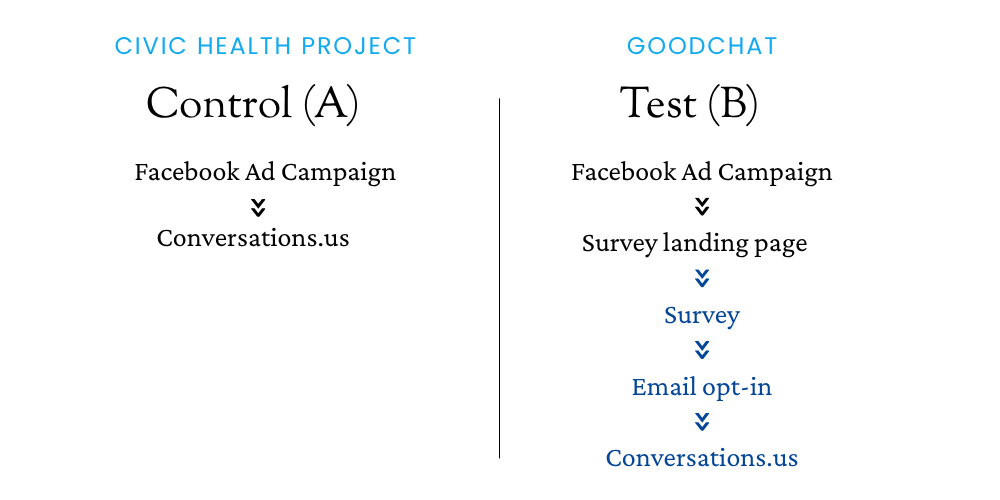
The first path reflected a standard awareness campaign: fast, direct, and largely transactional. The second invited people into a short but meaningful journey: pausing to reflect, share perspectives, and connect around shared values before ever being asked for an email.
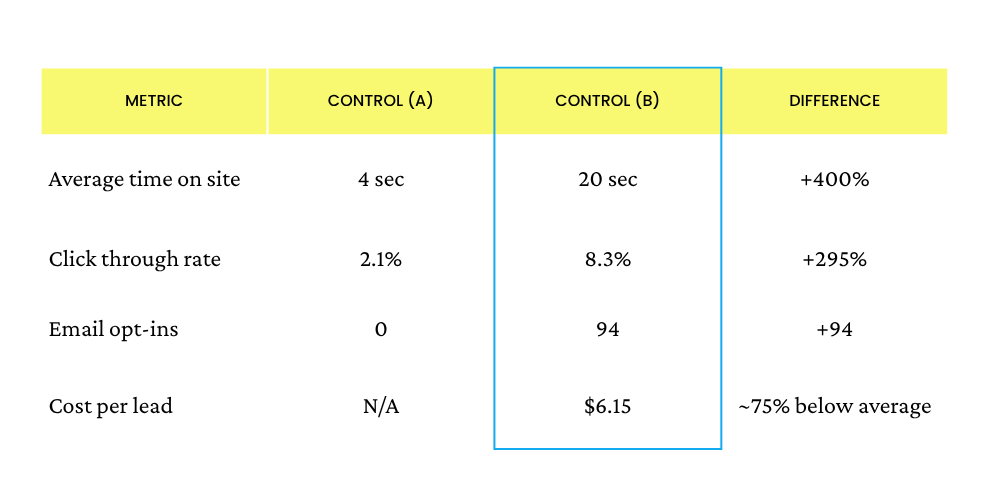
Despite adding three extra steps, the GoodChat funnel didn’t just hold attention—it deepened it. Every metric, from completion rates to opt-ins to donor intent, outperformed the control by wide margins.
And most importantly:
👉 29 donor prospects identified themselves in the survey —31% of leads.
👉 17 users opted in and expressed donation intent—clear, high-value leads.
Every step in the journey built a sense of mutual respect.
Instead of rushing to capture data, the campaign invited participants to reflect on something deeply personal: their hopes for the future of democracy.
The language was clear, human, and warm.
The experience was designed to feel like an invitation—not a transaction.
We didn’t just ask for emails; we earned them. - Civic Health Project
Our top-performing ad led with "Heal the Divide" messaging. It didn’t provoke; it invited. That one ad delivered 94% of all survey conversions.
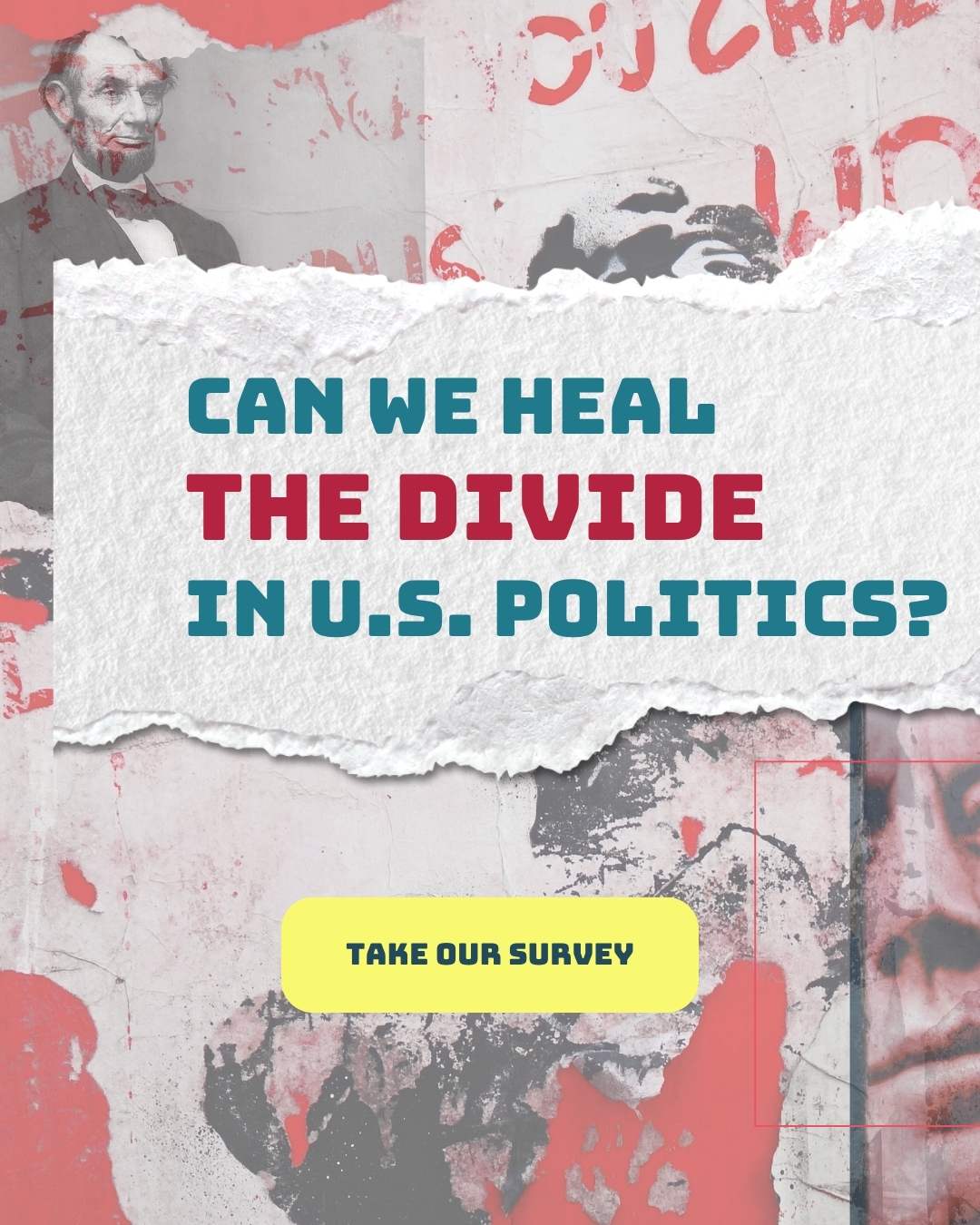
The chatbot survey wasn’t just a “fill out this form” experience—it was a conversation. It felt more like a dialogue than a data grab by using:
By the time the participant was given an opportunity to provide their email, they already received something valuable: a sense of connection, a moment of reflection, and an invitation to be part of something meaningful.
Most politically adjacent ads get flooded with vitriol in the comments. Not this time.
Despite generating four times the comments, the GoodChat campaign required less moderation. Why? Because the tone of the campaign was positive, respectful, and trust-first. It set the tone for how people responded.
“I found the GoodChat campaign seemed to have fewer comments that needed to be hidden despite having a much higher rate of comments.” – Civic Health Project
This experiment flipped a common belief:
“More friction = lower conversions.”
But in this case, more friction, when layered with trust, joy, and value actually led to more engagement, better leads, and higher intent. It’s what behavioral scientists call motivational friction: thoughtful effort that deepens investment, filters for commitment, and earns the right to ask.
In just five days, the campaign drew in hundreds of civic-minded participants—and kept them engaged from start to finish.
But the real story lives beneath those numbers:
That’s not just interest, it’s intent.
And all at a fraction of typical acquisition costs: $6.15 per lead, compared to an industry average of $31–$53.
This wasn’t simply an efficient funnel. It was proof that when outreach feels human, people stay with it. The campaign didn’t chase clicks; it earned commitment.
It turned quick interactions into reflective moments and reflective moments into meaningful action.

GoodChat’s campaign transformed civic health interest into real donor activation, achieving results that outperformed industry benchmarks in both cost and conversion rates. By focusing on trust, engagement, and a touch of joy, we didn’t just capture emails—we uncovered the client’s most committed supporters and gave them a clear path to action.
🚀 Interested in acquiring high-intent donors for your cause? We're always up for a GoodChat.
Every inbox deserves something worth opening.
We send the kind of emails we want to open ourselves. Your info stays safe with us.
See you in our next GoodChat

201 North Union Street, Suite 110
Alexandria, VA 22314
hello@goodchats.co
©GoodChat 2025
Small Great Ventures is a SOC-2 Type-2 compliant venture studio firm that is committed to user privacy and data protection.