

In every epic telling of a successful fundraising strategy for a nonprofit organization, the first gift from a donor isn’t the story. It’s the opening scene.
Donor Lifetime Value (LTV) is one of the most powerful and misunderstood measures in nonprofit growth. It captures the full arc of a donor’s relationship with your organization, their loyalty, evolution, and cumulative impact, not just what they give in Year One.
We call this the Year One Problem: a pervasive short-sightedness where organizations chase immediate wins instead of compounding ones. It’s the difference between a flash of generosity and a story of sustained belief.
Most fundraising programs celebrate that first donation as the main event. But the real story, the one that defines the future, begins with what happens after. Do donors fade away, hold steady, or deepen their commitment?
Like any good narrative, the power lies in the tension between the plot and the character arc. The lifetime value of a supporter follows the same rhythm. It’s shaped by two intertwined forces: how long a donor stays and how much they grow. Together, they reveal not just what your supporters are worth today, but what they’re capable of becoming tomorrow.
Imagine your organization in Year One: 1,000 new donors, a wave of fresh enthusiasm, inbox pings, and promise.
Based on industry trends:
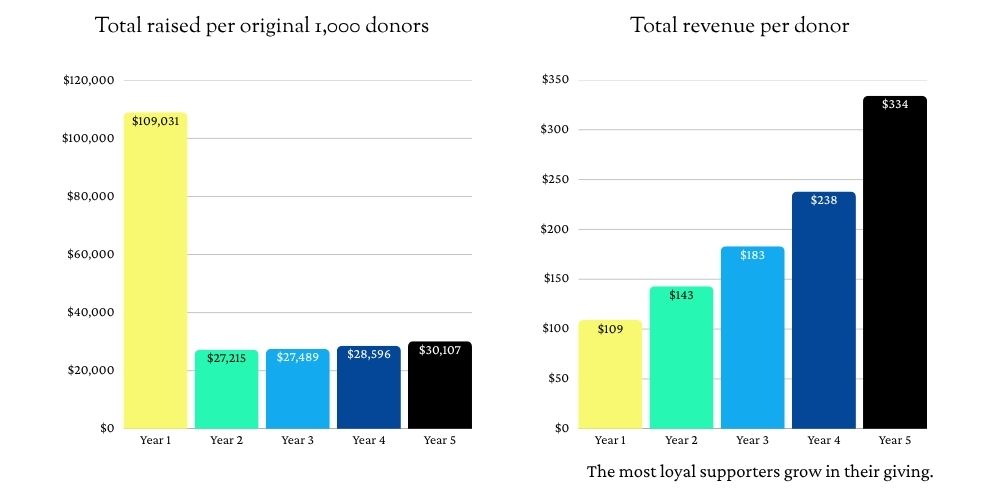
It’s a healthy mix of generosity: small gifts adding up to something big. By the end of that first year, your campaign has brought in roughly $109,000 in total revenue.
And then comes the drop.
The moment every development director knows too well. The cliff where excitement meets gravity. Retention rates fall, inboxes go quiet, and the data begins to separate those who gave once from those who are beginning their longer journey into belief.
By Year Two, only 19% of donors return. What began as a thousand voices has dwindled to just 190. The energy that once felt unstoppable begins to thin. Revenue falls with it, down to $27,215.
It’s the heartbreak chapter. The part of the story when many teams panic, double down on acquisition, or quietly brace for disappointment.
But if you look beneath the surface of churn and silence, you’ll notice something else is happening. A few donors are still here, holding steady. A few are even giving more. It’s faint, but it’s there: the first signs of a rebound, a quiet pulse of loyalty beginning to grow stronger.
And then, against all odds, the story turns.
Even as the number of active donors keeps falling (only 90 remain by Year 5 from the original 1,000), the total revenue begins to rise again. It’s a quiet, improbable ascent: $27,489 in Year Three, $28,596 in Year Four, $30,107 by Year Five.
Something remarkable is happening beneath the surface. The few who remain are no longer casual supporters; they have transformed into true believers. Some micro donors step up to the next tier. Small donors grow into midsize givers. A handful become the anchors, the champion supporters who don’t just give, but invest.
It’s a classic second-act reversal: loyalty and growth quietly compounding even as the crowd thins. What looks like loss is, in fact, transformation. This is the paradox at the heart of fundraising: sometimes, the story deepens only after the numbers fall.
By the end of Year Five, those original 1,000 donors had collectively given $222,438, which is a Donor LTV of $222 per person, even though most walked away after the first gift.
Here's the annual revenue from the original 1,000 donors:
Every compelling story has its structure and this is the part where we turn from plot to architecture.
Now that we know each donor is worth roughly $222 over five years, the next question is unavoidable: what did it cost to bring them into the story in the first place?
In the startup world, this is where the LTV:CAC ratio takes the spotlight: Lifetime Value versus Customer Acquisition Cost.
Think of it as the measure of sustainability beneath the storyline.
In a healthy business or fundraising program, it’s ideal to have an LTV:CAC ratio of at least 3:1. For every one dollar spent to bring in a donor, you earn three dollars back.
The best fundraising programs don’t just collect characters; they build systems where each new chapter pays off. Let’s see what that looks like when two teams take the same budget but tell very different stories.
Picture two teams beginning the same story with the same tools, the same ambition, and the same total fundraising budget. But when it comes to acquiring and growing their small-donor base, each team makes a different choice about where to focus.
Both allocate the same budget to small-donor growth: $100,000
Team A goes all in on acquisition. Their story opens with scale in mind; a big campaign, wide reach, and a strong launch.
They pour most of their resources into list growth, choosing quantity over quality, bringing in 1,000 new donors in Year One.
At first glance, it’s a hit. But beneath the surface, their system runs on averages:
Over five years, that cohort brings in about $220K in total revenue, or roughly $220 LTV per donor, the industry benchmark.
Their CAC for that segment? $100 per donor, producing an LTV:CAC ratio of roughly 2.2:1 - decent, but not sustainable for healthy growth.
Now picture Team B.
Same $100,000 budget, but they tell the story differently. They invest more of their energy into the donor journey itself: lead quality, message clarity, welcome experience, and consistent stewardship.
They acquire 900 new donors, much fewer than Team A, but their system performs better at every key step:
Those small advantages quietly compound. By Year Five, those 900 donors give about $305K in total revenue, or roughly $339 LTV per donor - a 53% lift over Team A.
Even with fewer donors, Team B raises significantly more total revenue from the same spend.
On top of that, their CAC:LTV ratio comes in just above the golden 3:1 target. Their strength isn’t reach; it’s resonance.
Both teams tell strong opening scenes. Only one builds a story that maintains quality throughout the whole journey. The best fundraising strategies read like good storytelling: every scene earns its place, every investment advances the arc, and every donor who stays makes the next chapter possible.
High acquisition costs can feel like a budget issue. But often it’s about how you're optimizing your budget to capture the right story and audience.
When your cost per donor runs high, it’s not always because you’re overspending. It may be that your story isn’t landing where it should. Maybe you’re speaking to the wrong audience. Maybe your message stops at the moment of conversion, instead of building toward what happens after.
Understanding your CAC isn’t about tightening belts; it’s about strengthening narrative. When you know what it takes to bring someone into the fold, and what keeps them there, you can write smarter chapters.
Ask yourself:
The math, in the end, is just another kind of storytelling. It tells you where energy gathers, where attention fades, and where belief turns into momentum. Once you know your LTV and CAC, you’re not guessing the ending anymore. You’re leading with data and building a strategy that can scale.
Every fundraiser knows retention matters. But few recognize how powerful growth can be with growing the inner circle of believers.
When you build systems that help donors rise, when the story you tell invites them to take on larger roles, you turn decline into focus, prioritization, and optimization. As the cast gets smaller, the plot deepens. Even as your donor base shrinks, revenue can grow if you have the systems in place to help people move up the giving ladder.
That’s the heart of donor upgrades: they don’t just offset attrition; they reveal evolution.
From churn to climb, from flash to foundation—this is how long-term revenue is written.
Not as a straight line, but as a story that learns from itself, each year a new chapter of persistence, generosity, and trust.
In upcoming posts, we’ll explore:
Sustainable growth doesn’t come from chasing numbers. It comes from understanding them.

Every inbox deserves something worth opening.
We send the kind of emails we want to open ourselves. Your info stays safe with us.
See you in our next GoodChat



201 North Union Street, Suite 110
Alexandria, VA 22314
hello@goodchats.co
©GoodChat 2025
Small Great Ventures is a SOC-2 Type-2 compliant venture studio firm that is committed to user privacy and data protection.